Operationalising Innovation: Scaling design strategy within a 15-Year-Old legacy ecosystem.

When the high-stakes, accelerated deadline landed, the instinct across the program was to move faster. I took a different call, moving faster without the right foundations would cost more time than it saved. So before a single screen was designed, I architected a design-led operational framework that enabled a 90% reduction in time-to-market. By aligning design, product, business, and development roadmaps, I moved the organisation from a reactive digital assembly factory to a proactive product-led strategy.

This program became the clearest proof that true product leadership involves the 'strategic pause'. By combining both my systems and product thinking, I deliberately took the time to design the process, define our strategic intent, and align our delivery with long-term business goals.

One of the existing B2C designs

One of the existing B2B designs (screenshot)

About Ignite, the digital transformation program, and its challenges

One of Synechron's flagship clients, du is a leading UAE telco undergoing a multi-million dollar transformation, called Ignite, which is to reimagine how a conventional B2C and B2B telco business operates in a digital-first world. With the UAE's ambitious vision of becoming a global leader in AI and innovation by 2031, it is vital for du to continue to innovate at speed 🚀.

The challenge and why Ignite exists

Transforming the technology was one thing, but transforming how people worked, their thoughts, and their culture, was a challenge entirely its own.

Legacy Business Processes

Legacy Business Processes

Over 15 years old legacy still functioning until this day. Complex navigation, no brand personality, and an experience that hadn't kept pace with modern customer behaviour.

Outdated Organisational Ways of Working

Rigid SLAs, siloed teams, and last-minute priority changes that kept everyone from moving as one. Unnecessary friction that made collaboration harder than it needed to be.

Fragmented Tech Stacks & Frameworks

A fragmented experience across channels built across multiple stacks. With a design system only partially utilised and 80%+ of the codebase remaining non-configurable.

The challenge and why Ignite exists

Transforming the technology was one thing, but transforming how people worked, their thoughts, and their culture, was a challenge entirely its own.

Legacy Business Processes

Over 15 years old legacy still functioning until this day. Complex navigation, no brand personality, and an experience that hadn't kept pace with modern customer behaviour.

Outdated Organisational Ways of Working

Rigid SLAs, siloed teams, and last-minute priority changes that kept everyone from moving as one. Unnecessary friction that made collaboration harder than it needed to be.

Fragmented Tech Stacks & Frameworks

A fragmented experience across channels built across multiple stacks. With a design system only partially utilised and 80%+ of the codebase remaining non-configurable.

About Ignite’s experience design studio

The design team is a 20+ member, 10+ nationalities spanning strategy, design, and UI development. Innovation-led and powered by AI and emerging technology, the team exists to build the digital products, services, and experiences that define du's future.

About my role within Ignite's experience design studio

I worked closely with the Head of Design to make sure his vision actually saw the light of day, and over time, became a fractional extension of the role itself.

But my reach didn't stop at the design team. I partnered with Architecture, Business, Product, and Development – extending across 150+ interdisciplinary stakeholders in 15+ countries, both specialists and leadership alike.

In essence, I became the connective tissue between the experience side and the business side – across every vertical, every channel. When a decision needed both perspectives in the room, I was usually already standing for both.

Over time, that meant being the go-to person teams turned to when they needed to understand not just what good looked like, but what good would cost, what it would take, and what it would mean for the business on the other side.

Where I operate: the connective layer between how the business runs and how customers experience it.

Ignite's Design Strategy

As mentioned before, Ignite inherited a 15 year old legacy of business processes and decisions. My job was to decide what stayed, what got rebuilt, and what got reimagined entirely.

As mentioned before, Ignite inherited a 15 year old legacy of business processes and decisions. My job was to decide what stayed, what got rebuilt, and what got reimagined entirely.

Our workflow was organised into four phases, adopted from the typical double-diamond process to ensure a balance between discovery and delivery.

We began by rigorously questioning where we want to be, then mapped genuine customer challenges, which then informed our definition of what to build and how to effectively prioritise development within existing technical constraints.

Visionary work

Ran a cross-functional workshop with Business, Product, and Development to establish a Norht Star stretegy and defined what success looked like once the program was fully launched.

Personification

Aligned on core customer segments within Consumers, Entrepreneurs, and Small Businesses in driving both satisfaction and revenue, ensuring every decision are grounded to real users.

Trade offs

Surfaced the key decisions between our team and the core stakeholders that could limit the North Star strategy, particularly compliance risks, to avoid becoming blockers later.

Prioritisation

Transaction time was a recurring pain point. I prioritised the roadmap around it, sequencing high-impact drops measured from the number of user and the potential gross ads revenue.

Visionary work

Ran a cross-functional workshop with Business, Product, and Development to establish a Norht Star stretegy and defined what success looked like once the program was fully launched.

Personification

Aligned on core customer segments within Consumers, Entrepreneurs, and Small Businesses in driving both satisfaction and revenue, ensuring every decision are grounded to real users.

Trade offs

Surfaced the key decisions between our team and the core stakeholders that could limit the North Star strategy, particularly compliance risks, to avoid becoming blockers later.

Prioritisation

Transaction time was a recurring pain point. I prioritised the roadmap around it, sequencing high-impact drops measured from the number of user and the potential gross ads revenue.

What we built

Every decision traced back to the design strategy, shaped by our North Star vision.

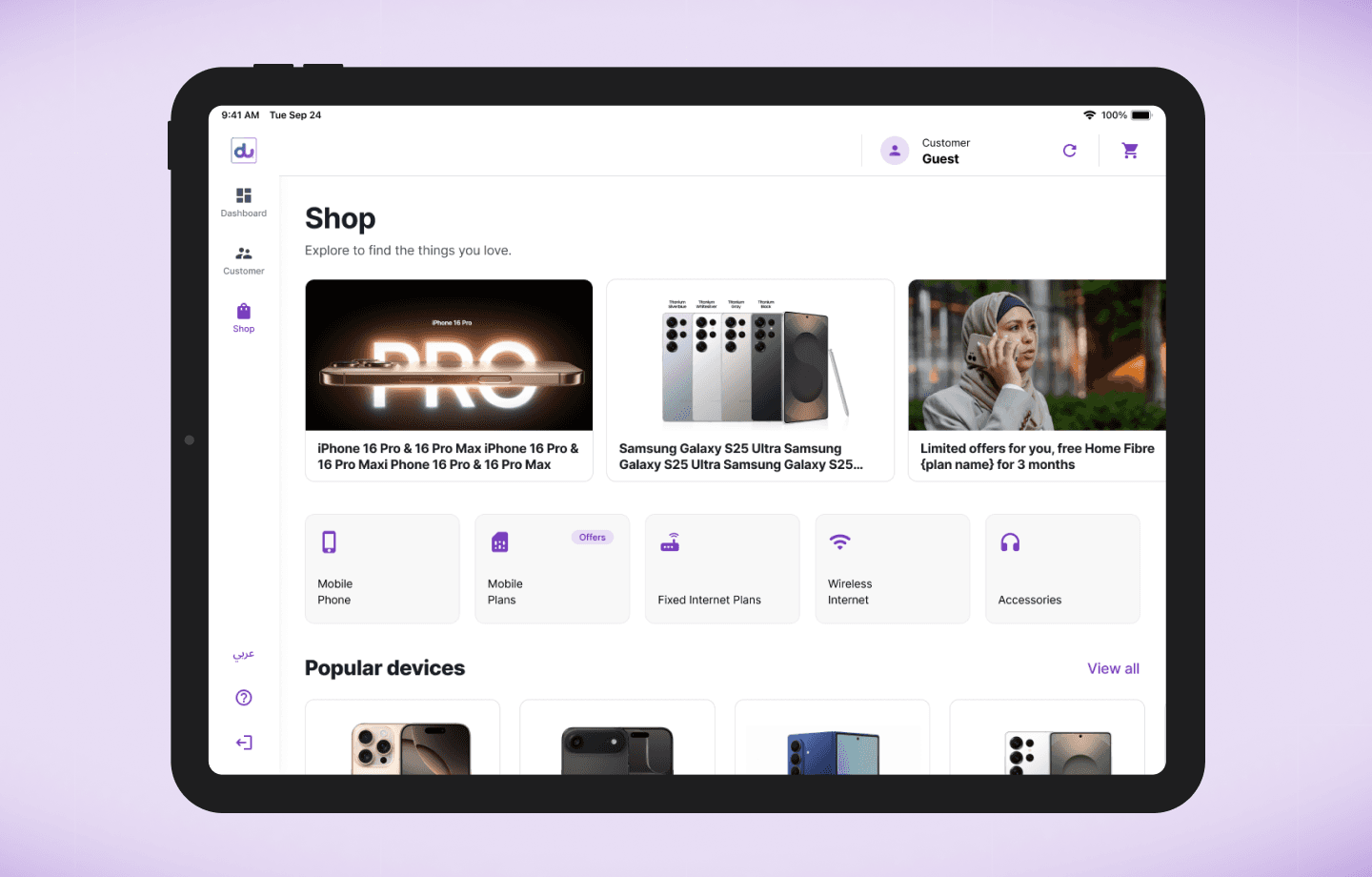
The result was a digital-first experience across App, Web, and Tablet — built for Consumers, Entrepreneurs, and Small Businesses, with compliance safeguarded at every step and transaction time treated as a non-negotiable metric.

Specific flows remain under NDA, but the principles behind them. The main goal is to bring clarity, consistency, and speed without sacrificing trust.

Go to market time

Digital adoption & interaction

Cust. satisfaction score

Regulatory compliance

Customer transaction time

Billing queries & disputes

Agent handling time

Customer complaint

Why ‘just ship it’ wasn't enough (and how we shifted gears)

I dedicated two weeks to refine the operational workflows and defining the team's product strategy. However, introducing such degree of changes were met with stakeholder hesitation. I frequently encountered the same question:

"Why all the trouble? You could've utilised your time in actually designing."

I understood their stance; in our fast-paced environment, two weeks in a significant investment. To put into perspective, my most senior designers could've completed at least 2 journeys. But I still fundamentally took a different view, the time I've spent building a robust foundation would eliminate future redundancies and reworks.

But just through debating would not erase any skepticism, I wanted to demonstrate them. In order to prove the point, here's what I did:

  • Owned the design and strategy of a high-stakes product. Through leading by example, I applied my operational foundation in an actual environment and test them. I delivered a high-quality, scalable, 0-to-1 product experience without skipping a requirement. I prioritised in crafting journeys with the highest degree of reusability to maximise the time before tackling a more complex ones.

  • Owned the version control across multiple journeys and channels. I implemented a rigorous design governance model to align designers output with the core workflows. I continuously optimised our design file structure, focusing on journey presentation to ensure stakeholders could skim through the intent and rationales behind our designs.

  • Led design handoff and refinement sessions with stakeholders. Leveraging the foundations I established, I provided technical oversight to the team, managing on-demand design fixes and workflow inquiries. I made sure to keep track using Figma's "Branch" feature in each of the changes, and always mark each feature as “Ready for Devevelopment” with a digestible changelogs.

A high level summary of the design process I built and evangelised to the whole program

What I embedded into the program

When Ignite kicked off, everything I'd previously built was about to be stress-tested at scale. To ensure that the program thrived, I moved beyond standard collaboration and established a formal Operational Governance model. By architecture four core pillars, I collaborated closely with 150+ stakeholders, transforming fragmented efforts into a high-velocity, predictable delivery engine.

Project planning and scoping

At the very beginning, I insisted on mapping the full landscape first. Starting without a clear picture of what already existed would have cost far more time downstream than the mapping exercise itself.

  • Conducted a comprehensive UX audit and reconstructed the information architecture to improve usability and experience quality

  • Led workshops with business, product, and user teams to surface pain points and identify opportunities

  • Mapped every journey at a high level to properly estimate and identify its reusability, cutting down delivery time immensely.

Strategic resourcing

When (almost) everyone in the program thought to get all hands on deck, I pushed back. What the program needed was needed the right profile with the right context and the right skillset, deployed deliberately.

  • Mapped product roadmaps against design needs, collaborating with Design Leads to estimate effort across every workstream

  • Matched each product to designers with the right skillset and deep persona knowledge across B2C and B2B

  • Established a design task force to absorb ad-hoc requests and last-minute changes without disrupting core delivery

Radical transparency

In a program this complex, the most dangerous thing is a missed signal, especially towards the executives. I made visibility non-negotiable from day one, not as a reporting obligation, but as a trust-building strategy.

  • Delivered weekly progress reports giving every stakeholder an honest read on delivery status.

  • Launched monthly design show-and-tell sessions — turning passive observers into active advocates

Design and production support

Most teams treat quality assurance as someone else's problem, but I introduced a Design QA. Identifying build discrepancies and document them properly, avoiding potential additional cost of catching after launch.

  • Managed end-to-end design QA and version control, systematically comparing live builds against Figma designs before handoff

  • Introduced design refinement sessions, aligning stakeholder feedback against existing designs before anything moved downstream

One of the examples of myself owning the branches in one of the

Beyond the organisational foundations and project delivery, I have also added direct value to the program itself.

Every program has a version of the same question,

"Where is the latest version of that file?"

"Who's checking whether the build actually matches the design?"

"Which version are we actually building from?"

"Can we use the Design System components properly this time?"

A good question, sure. However this is a problem everyone noticed, but nobody had the capacity to solve at scale. I believe it was wise to invest time upfront would save countless downstream, especially on a program of Ignite's magnitude. Beyond leading the overall delivery, I also:

Related case study: Scaling design systems as a driver for business growth.

Enabled Design System as non-negotiable.

I established a sign-off process that includes Design System, led the creation of a template library with full EN & AR support, and co-led the strategy for multi-brand design tokens.

Introduced design quality assurance.

As an extension of the above, I established a feedback loop that had never formally existed before. For the first time, the design team owned the entire review cycle from end to end, rather than leaving downstream.

Overhauled the file structure

I created the end-to-end journey into a system readable by designers and non-designers alike, reducing journey refinement sessions from 3 weeks per journey to 1.5 hours across the entire program.

Created rigorous version control

I personally introduced and managed branches and changelogs throughout delivery and ensuring every feature was clearly marked "Ready for Dev" with digestible handoff notes.

What it all added up to (Or.. impacts)

Honestly? I still don't know how we pulled it off. But when I look back at every decision made, every piece fell exactly where I intended it to. Across the operational foundations, the design contributions, and the 0-to-1 build — every decision was deliberate. Here's what it all added up to.

3

Channels

App, Web, Tablet

120+

Journeys

300+

Features

1,600

Days estimated work

Pre-transformation

20

Weeks delivered

~$10mio

Budget optimised

The ripple effect

Beyond the product success, the design foundation I built rippled throughout the organisation. The most tangible example of this was our UAT process. By leveraging the new operational framework, I condensed a journey-review cycle that historically took three to four weeks into a 90-minute session for 60+ stakeholders.

This was to help ensure design and non-designs alike are aligned, validated, and ready for launch at unprecedented speed.

Personal Reflection

For the first time ever, I proved that DesignOps is an operational strategy, rather than support. By leading this program, I moved out of the shadows and into the center of the business, where the impact was very visible and recognised with scale. What began as a role without a name became the foundational backbone of a complex digital transformation.

However this wasn't an easy ride, as the changes were initially met with hesitation. As mentioned in the previous chapter, I chose to lead by example by taking ownership ownership of a high-stakes journey. I got my hands dirty and personally apply the new systems in real-time, and then demonstrated the value of investing in time to save time in the long run, all the while not sacrificing quality. This approach has effectively removed all skepticism, proving that the 'Just Ship It' mindset way was costing us more than it was saving.

You don't find out what your foundations are worth until everything is on the line. Now I know, and so does everyone who was in that room. This taught me more than just having to lead proejcts, but having redefined how the organisation interprets the value of a design-led ecosystem.

Let’s get in touch 🤙🏼

Always open to conversations! Whether it's about Design Operations, Design Leadership, UX/UI Design, or just exchanging notes on what's working and what isn't. Looking to bring on a Product Design, want to collaborate, or just want to geek out? Let's have a chat

Contact me