Coming in to this role, I noticed one reality. Design was treated like a part in an assembly line within a digital factory. Our internal ecosystem was ridden with technical debt, siloed processes, eventually turning design into huge bottlenecks rather than value-driven.
By replacing the chaos with a unified operating model, I eliminated systemic friction and transformed our design organisation into a high-functioning team that directly impacts product delivery and drive business outcomes.
Role
DesignOps Lead
Duration
4 weeks
Scope
Craft an organisational design infrastructure required to move with speed without sacrificing quality.
Teams involved
20+ Multinational Designers
Head of Product
Head of Development
Impact summary
Accelerated overall organisational delivery by 400%
Reclaimed ~$5M+ in the program's expenditure
Cut development handoff and refinement time from ~1 month down to 1.5 hours
Cut stakeholder search time for the right screens from ~2 hours down to seconds

Why this project came to be?
Good question, my young padawan. This was the very first challenge I had involved myself into. When I joined, there was only one clear instruction from my conversation with my Design Director at the time (Kizz Ahdan):
"Fix this mess of a process, please"
The problem with that, was that there was practically zero existing works to build on top off. That was literally our first conversation. I came in to this role with only hopes and prayers. No existing works or handovers, no mentor, and this is the first time I’m working officially for the role. I stared at my clean screen for like half of my first day and thought,

Definitely not a leaked chat between me and Kizz
The messy beginning: attempting to untangle the wires
Getting to know the people
DesignOps at its core is designing how design works. The question Kizz had given me was actually deceptively simple: understand how designers deliver, and what's getting in their way. Before I could fix anything, I went back to basics as I needed to answer a more fundamental question.
Who exactly am I designing for?
The answer was more obvious than I expected. The fastest way to integrate into any organisation isn't through forcing your own frameworks, it's through people. Understanding what their chemistry and culture was, establish the rapport early, then build something they'll actually use. So I spent my first two weeks on 1-to-1s and informal conversation, understanding how the team dynamics work.
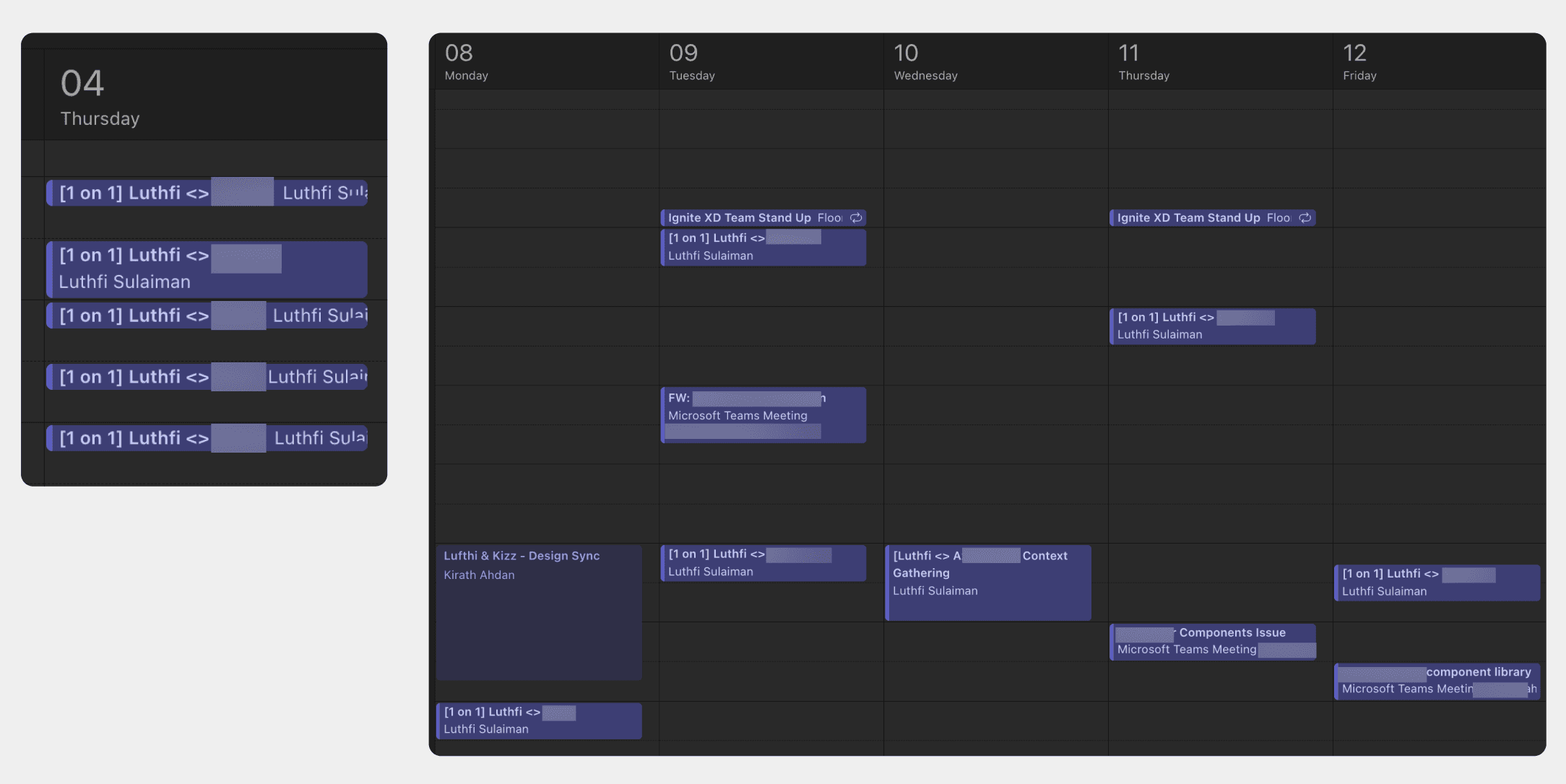
My first week was filled with formal (& informal) knowledge gathering, 1-to-1s, and tons of design kick-offs
Gathering their thoughts together
Everyone has their own working style. The team's avoidance of process innovation was due to a perceived need for speed in a high-pressure environment where structure was sacrificed for delivery. This, combined with poor onboarding and fragmented handoffs, created a cycle of institutional knowledge loss that wasted significant time whenever ownership changed hands.
Figma files strongly requires more scalability. Fragmented, siloed file structures created significant operational friction, forcing designers to spend hours in navigating disorganised files that were incomprehensible to anyone other than themselves. This systemic lack of standardisation resulted in performance bottlenecks that even high-end devices struggled to overcome.
Designers wants to be more closely involved with the business decisions. Without it, designers are prone to last-minute changes, resulting in friction. While the designers' instinct to engage with business strategy was correct, the lack of proper involvement led to cognitive overload; the end goal was to shift this engagement earlier in the process to influence direction before it became bottlenecks.
Visualising the problem
Without a shared process, every designer had developed their own way of working with no shared rulebook and no common language. In a glance, it is understandable under pressure, but it meant business decisions and deliverables were drifting apart with no shared reference point to catch it.
In another sense, the design team was just a group of talented people doing things their own way and hoping they would somehow finish together.

This is how I imagine what we could be doing as a team.
Mapping out the existing frameworks
Next came synthesis, same approach as any UX Research exercise. I’ve mapped everything end-to-end, let the pattern surface, and very quickly it did.

Existing Workflow Framework
Two stages consistently lit up with frictions, 'Craft Designs from Assigned User Stories' and 'Ad-hoc Design Adjustments', while everything else was manageable. These two were quietly bleeding the program's time, creating a feedback loop that slowed delivery and left even less room to clarify requirements properly.
It is a hellish loop, rather than a one-off problem.
Settling in the opportunities from a formal workflow
By the end of my second week, I had gathered enough context, and confidence to move from observing to doing. I ran a workshop with the entire Experience Design team. I opened the workshop with a simple exercise where everyone wrote down the problems they'd faced. The results matched my own research almost to the tee. I then walked the team through what an end-to-end design process could look like.


By the end, the room was aligned, and the team gave their trust to push it forward. Which meant two things: First, finish the end-to-end proposed process, and second, get the approvals from director-level. The Lead POs, Lead Architect, Engineering Manager, Lead Delivery Manager, to name a few.
The proposed framework
One thing from the workshop stuck with me. I didn't need to build a new process from scratch. The process technically had already existed for three years. It lived under the team’s muscle memory, but nobody had ever taken the time to formalise it.
So to anyone looking in from the outside (or a new joiner), it seemed like it never existed at all.
I chose to not reinvent the wheel, rather giving it a proper shape.
What I built was grounded in what the team already familar of, with minor improvements where the gaps were obvious. Familiar enough to trust. Structured enough to actually follow.
I crafted it in four layers, each one designed for a different audience.
First layer – the helicopter view.
A high-level summary of the entire workflow that gave stakeholders a clear picture of how design moves from start to finish without getting lost in the details. Enough to understand, but not so much that it slows anyone down.

Second layer – stage-by-stage breakdown
I mapped every stakeholder touchpoint. Who does what, when, and what the expected output looks like. Each stage had a clear status and a defined next step. Design System and Content Writers included, not as afterthoughts but as named parts of the pipeline.

Third layer – mathemetical breakdown
I created a set of calculation frameworks, almost research paper-style, to give Product Owners a concrete basis for managing expectations, allocating resources, and making prioritisation with confidence.

Fourth layer – tying everything together
I created a Navigator file, rather the first iteration of it (more in my other case study) a single reference point where all relevant design files lived, including the process itself.

Getting sign offs
The last (but not least) in the crafting hurrah, and honestly, the most straightforward one.
Everything I had done from the start will be decided if it were to become the workflow going forward. I summarised everything in a presentation deck, scheduled a meeting with the directors to walk them through the full end-to-end process.
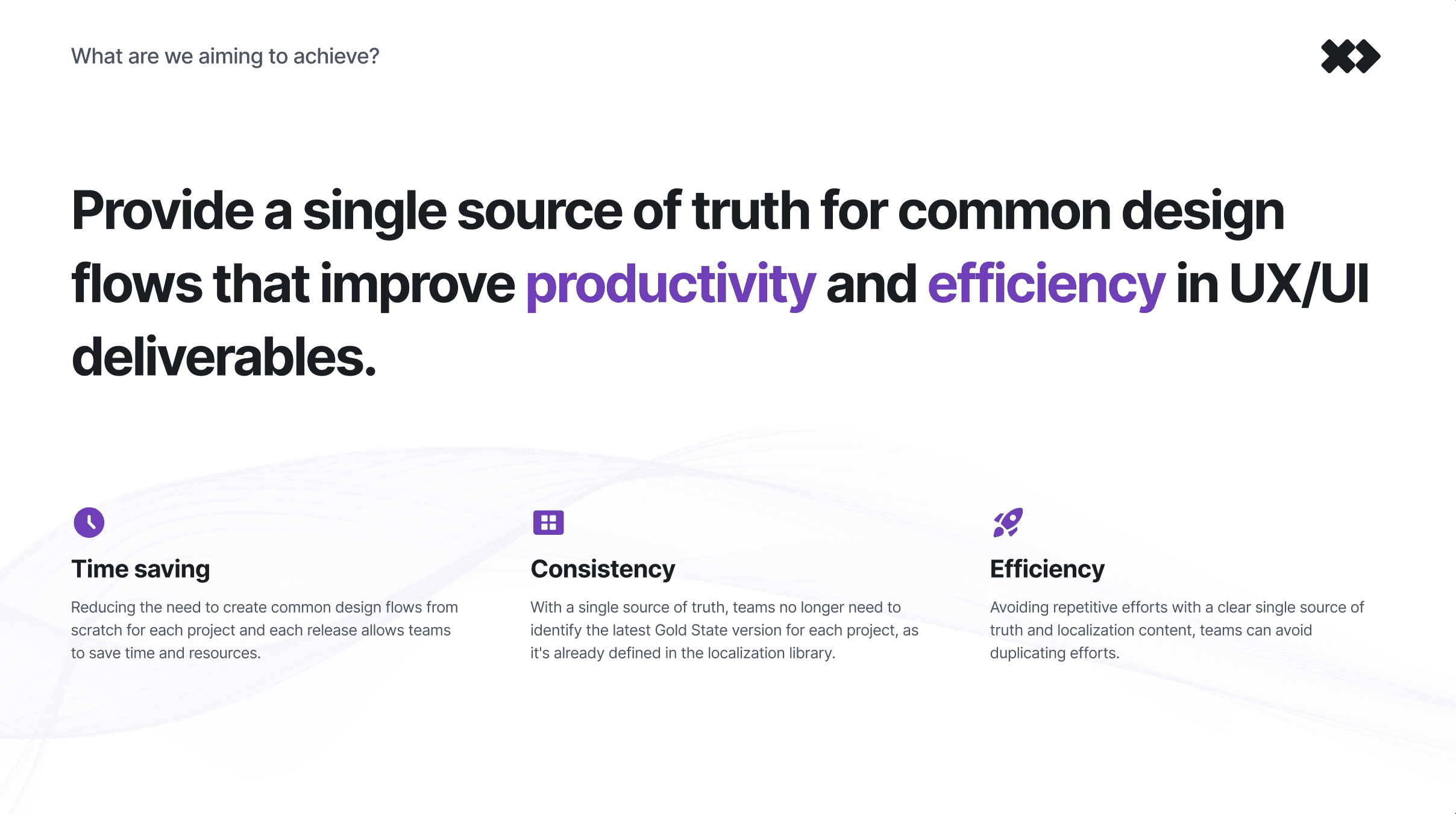
Quick preview on the presentation for the proposed process
Kizz joined the session too. He'd been there since the very beginning and made it clear from the start he was fully behind it. And the reaction across the board was more friendly than I initially expected.
"Finally someone made sense in this company."
-Word by word quote from the Lead Product Owner. I'm keeping this forever.
With that, the process had signed off by itself.
Outcome
The proof came faster than expected. The process I’ve built was now a foundation of what was to come later, and it is still used today!
Accelerated delivery for a full UX/UI journey design across all three channels (App, Web, and Tablet) by 400%.
The Navigator file was able to reduce hours of back-and-forth conversation in finding the right frame in the right file to only a few seconds.
Eliminated structural silos to optimise operational overhead, reclaiming ~$5M+ in the program's expenditure in the process.
Personal reflection
What could have been the worst start to a DesignOps career turned out to be the best one I could have asked for. I came in with no process, no structure, and no roadmap. I finished half of my year having built a complete operational framework.
This transition was built on years of informal experience; when the pressure hit, I didn't need long to find my footing. The journey was undeniably complex, but it solidified my path.
It was bumpy. It was worth it. This case study served as a final confirmation of what I’ve always known: I am at my best when I am building the systems that allow design to scale.
Let’s get in touch 🤙🏼
Always open to conversations! Whether it's about Design Operations, Design Leadership, UX/UI Design, or just exchanging notes on what's working and what isn't. Looking to bring on a Product Design, want to collaborate, or just want to geek out? Let's have a chat
Contact me